My eyes were the part I couldn't hide
With Graves', a lot of what you go through is invisible. The racing heart, the anxiety, the exhaustion. People can't see it.
Thyroid eye disease is different. It shows up right on your face: puffiness, redness, irritation, sometimes bulging. You notice it in every mirror and every photo. I know because I lived it.
And for a long time, I never thought of my eyes and my gut as connected.
If you read my last post on the gut-thyroid connection, you know my gut was a mess. Stomach pain, bloating, no safe foods, expensive probiotics that did nothing. What I didn't fully expect was that working on my gut would show up in my eyes too.
The photo below is February 2024 vs. August 2024. Same girl, same eyes, six months apart, after I finally addressed what was going on in my gut.
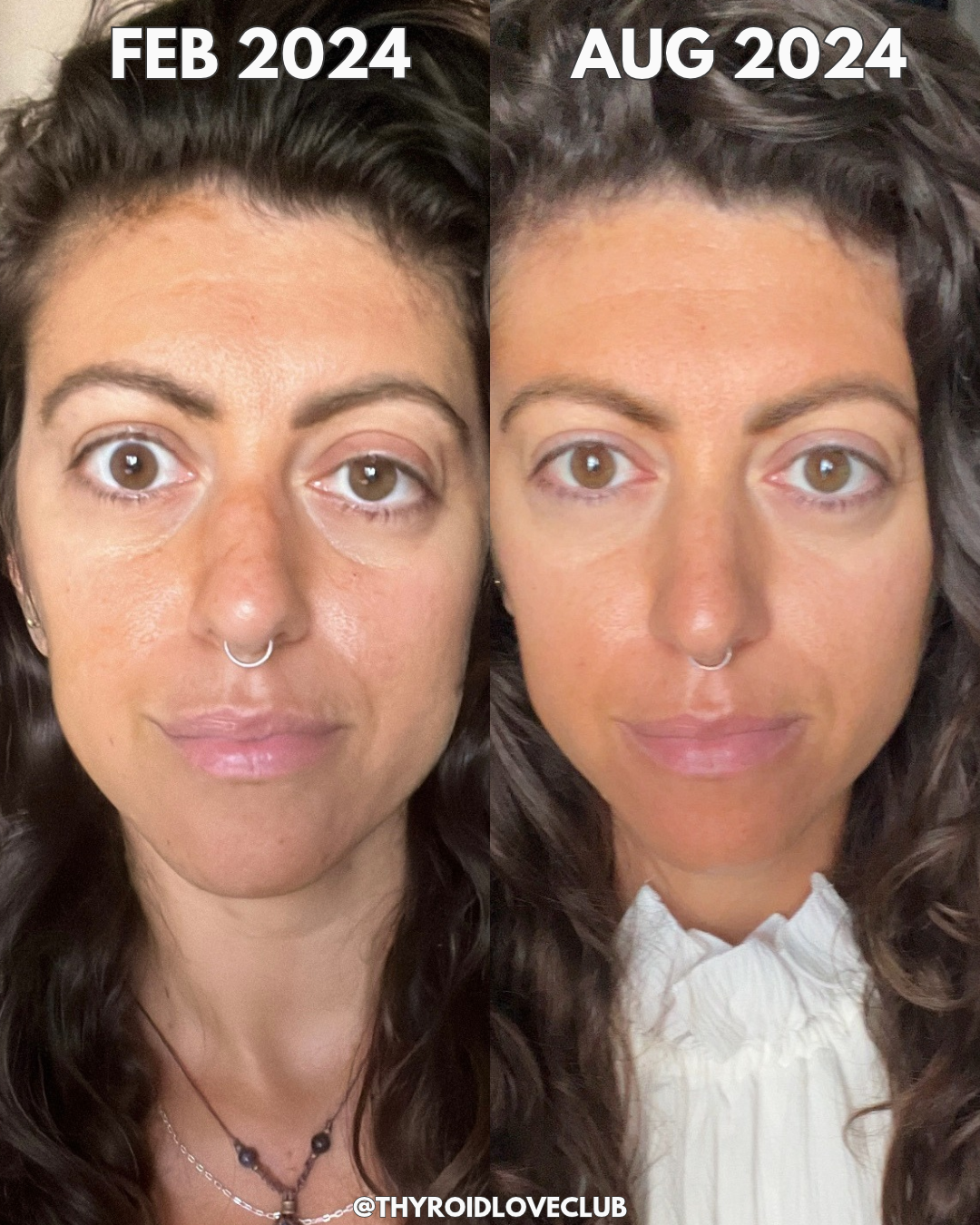
February 2024 vs. August 2024, after addressing my gut
So let's talk about it.
TED is an immune problem, not just an eye problem
Thyroid eye disease (also called Graves' orbitopathy) is autoimmune. The same antibodies that overstimulate your thyroid in Graves' can also target the tissue and muscles behind your eyes. That's what causes the swelling, redness, pressure and bulging.
So the eyes are where it shows up. But the question I always come back to is: what is driving the immune system to act this way in the first place?
That's where the gut comes in. Around 70% of your immune system lives in and around your gut. When the gut lining is irritated, when there's an overgrowth or an infection, or when the balance of bacteria is off, your immune system is on high alert all day long.
Researchers have found that people with Graves' and with thyroid eye disease tend to have a different gut microbiome than people without them. It's still early research, and it doesn't mean your gut is the only piece. But it lines up with what I saw in my own body and what I see with clients.
Things I think about when it comes to the gut and TED:
Gut infections and overgrowths that keep the immune system stirred up
A leaky, inflamed gut lining letting more through than it should
Low stomach acid and poor digestion, which affect how well you absorb nutrients
Nutrient gaps that matter for the eyes and the immune system, like selenium, vitamin D and zinc
Food reactions that add to the inflammation load
What I found in my own gut
I tried the probiotics. I tried the "safe" foods. None of it touched the real problem, because I didn't know what the real problem was yet.
I happened to do a stool test while I was in Mexico, and it found Blastocystis hominis. When I got back to the states, I ran a functional stool test (a GI-MAP). It found the Blasto too (still there even after a round of antibiotics), and it showed me a much bigger picture of what was going on in my gut. Here's what it found.
Blastocystis hominis, the same parasite the Mexico test caught
H. pylori, a bacteria that can lower stomach acid and that research has linked to Graves'
Overgrowths of Enterococcus, Pseudomonas and Streptococcus, opportunistic bacteria that are fine in small amounts but were running the show in my gut
Elevated zonulin, a leaky gut marker
Low secretory IgA, a sign my gut's immune defenses were worn down
The leaky gut markers were the part that made it click for me. Zonulin is the protein that opens the tight junctions between the cells lining your gut. When it's high, the lining gets more permeable, and more of what should stay inside your gut (bits of food, pieces of bacteria) gets in front of your immune system. That's a lot of extra fuel for an immune system that's already overreacting.
Secretory IgA is your gut's first line of defense. It coats the gut lining and helps keep bugs in check. When it's low, it's often a sign of long-term stress or infection, and it makes it easier for things like Blasto and H. pylori to stick around.
And that wasn't even the whole story. Later on, my Metabolomix (an organic acids test) found Candida too. Yeast likes to hide along the gut lining instead of showing up in every stool sample, so a stool test can come back clear on yeast even when it's part of the problem. That's one reason I don't rely on just one test.
So I had infections and yeast keeping my immune system on high alert, a gut lining letting more through than it should, and defenses that were too worn down to fight back. An immune system dealing with all of that every day is not a calm one, and for me, that showed up in my eyes.
That test changed everything for me. Instead of guessing, I finally had something specific to work on.
What I actually used
My protocol was built around my own test results, so please don't take this as a copy and paste plan. But I know you want specifics (I always do), so here's what I used.
To target the bugs
GastroMend-HP (Designs for Health) for the H. pylori. It has mastic gum, zinc carnosine, DGL licorice and vitamin C, which work against H. pylori while supporting the stomach lining.
ParaBiotic Plus (Nutra BioGenesis) for the Blasto and the bacterial overgrowths. It's a blend of sweet wormwood, berberine, neem, oregano, thyme, olive leaf, barberry, black walnut and uva ursi.
Candicid Forte (Ortho Molecular) for the Candida, with berberine, oregano, caprylic acid, pau d'arco, cinnamon, ginger, rosemary and chamomile.
To repair my gut lining
GlutaShield, a glutamine blend that supports the gut lining. My clients are on it and love it too.
MegaIgG2000 (Microbiome Labs), immunoglobulins that support the gut barrier and the gut's immune system, which made a lot of sense with my low secretory IgA.
To rebuild my microbiome
Multistrain probiotics to bring back beneficial strains, alternating with Seed and the spore-based MegaSporeBiotic.
Herbs and nutrients that can help with these bugs
These are the ones I look at for the same kinds of findings. Which ones make sense depends on what a test shows, and tests like the GI Advanced even show which herbs your organisms are sensitive to.
H. pylori: mastic gum, zinc carnosine, DGL licorice, broccoli sprout (sulforaphane), berberine
Blastocystis and other parasites: sweet wormwood (artemisia), black walnut, neem, oregano, berberine, garlic (allicin), plus the probiotic yeast Saccharomyces boulardii
Bacterial overgrowths (like Enterococcus, Pseudomonas and Streptococcus): berberine, oregano, thyme, olive leaf, uva ursi, garlic
Candida: caprylic acid, oregano, pau d'arco, berberine, cinnamon, undecylenic acid
A few honest notes from your pharmacist friend: herbal antimicrobials are strong. Some interact with medications, some aren't safe during pregnancy or breastfeeding, and going too hard too fast can make you feel worse before you feel better. Test first, and work with a practitioner who can match the protocol and doses to you. If you want that practitioner to be me, I'd love to help. We'll go through your results together and build a targeted protocol that fits you and your body. Apply to work with me here.
I know you guys are going to want to try these anyway, so I highly recommend getting them from a reputable source like Fullscript. There are a lot of fake supplements floating around on the internet, and some of these are provider-only anyway, so Fullscript is where you'd get them. You can find everything I used in my Fullscript shop, and you get 10% off through my link.
Once I addressed my gut with a protocol built around what my test actually showed, my digestion started to calm down. And over the next few months, so did my eyes.
What changed for me
I want to be really honest here. Working on my gut was not the only thing I did, and TED is complicated. Your eye doctor and your endocrinologist absolutely need to be part of your care.
But for me, the gut was a missing piece nobody had looked at. Once I took care of it:
My gut finally calmed down. No more pain, bloating or constipation. I was so much more regular, and I was able to bring back a lot of my favorite foods (while still eating the things I knew were no good for me, in moderation ;))
My eyes looked and felt better by August than they did in February. The bulging and retraction had calmed down, and my eyes looked a lot more symmetrical. I had less blurry vision and less dry eye, so I was using my drops way less. Less tearing, and my light sensitivity improved a tiny bit. I didn't feel that pulling behind my eyes anymore, and the headaches were gone.
Your story might look different. Maybe it's not an infection for you. Maybe it's low stomach acid, food reactions or nutrient gaps. There can also be other root causes, like stress, heavy metals, mold, toxins, other infections or insulin resistance, and the list goes on. That's why it's so important to test, and to work with a provider who knows what to look for.
That said, from what I've seen so far, EVERY client of mine has had some level of dysbiosis and gut barrier dysfunction. So the gut is always one of the first places I look.
Where to start if you have TED
If you have thyroid eye disease and your gut is giving you trouble (bloating, gas, burping, constipation or loose stools, or a list of "safe" foods that keeps getting shorter), it's worth a closer look.
Pay attention to your gut symptoms. They're information, not just an annoyance.
Ask about functional stool testing. It shows you a lot more than a standard test, so you're not guessing. I did a GI-MAP back then, but these days I prefer the GI Advanced by US BioTek or the Gut Zoomer.
Check your nutrients, especially selenium, vitamin D, ferritin and zinc.
Keep your eye doctor in the loop with anything you change.
If you want support with the testing piece, I can help you order functional labs (like the GI Advanced, Gut Zoomer or Metabolomix), walk you through what your results actually mean, and build a targeted protocol around what they show, so you're not guessing. You can use your FSA or HSA for it too.
One more thing, because I hear it all the time: a lot of my clients come to me after working with a functional provider who wasn't able to help them. That's why I really insist on working with someone who is Graves', TED, Hashimoto's and thyroid literate, and who has real experience with these conditions. Coaching is amazing, but you also need someone who understands the clinical side of what's happening in your body, and who has access to the full range of testing, not just the tools that happen to be available to them. When you work with me and my team, you get access to everything that's medically necessary.
If you want help figuring out what's going on with your gut, thyroid and eyes, you can see how I approach gut health or book a consult.
And if you just want to be around people who get it, come to the free monthly Thyroid Love Club support group. Come as you are, pajamas welcome. There's no need to perform or show up any certain way. Just be yourself in a room full of people who have been through exactly what you've been through. No need to overexplain. We've been there, and we understand.
xo, Elena